 Lunchball
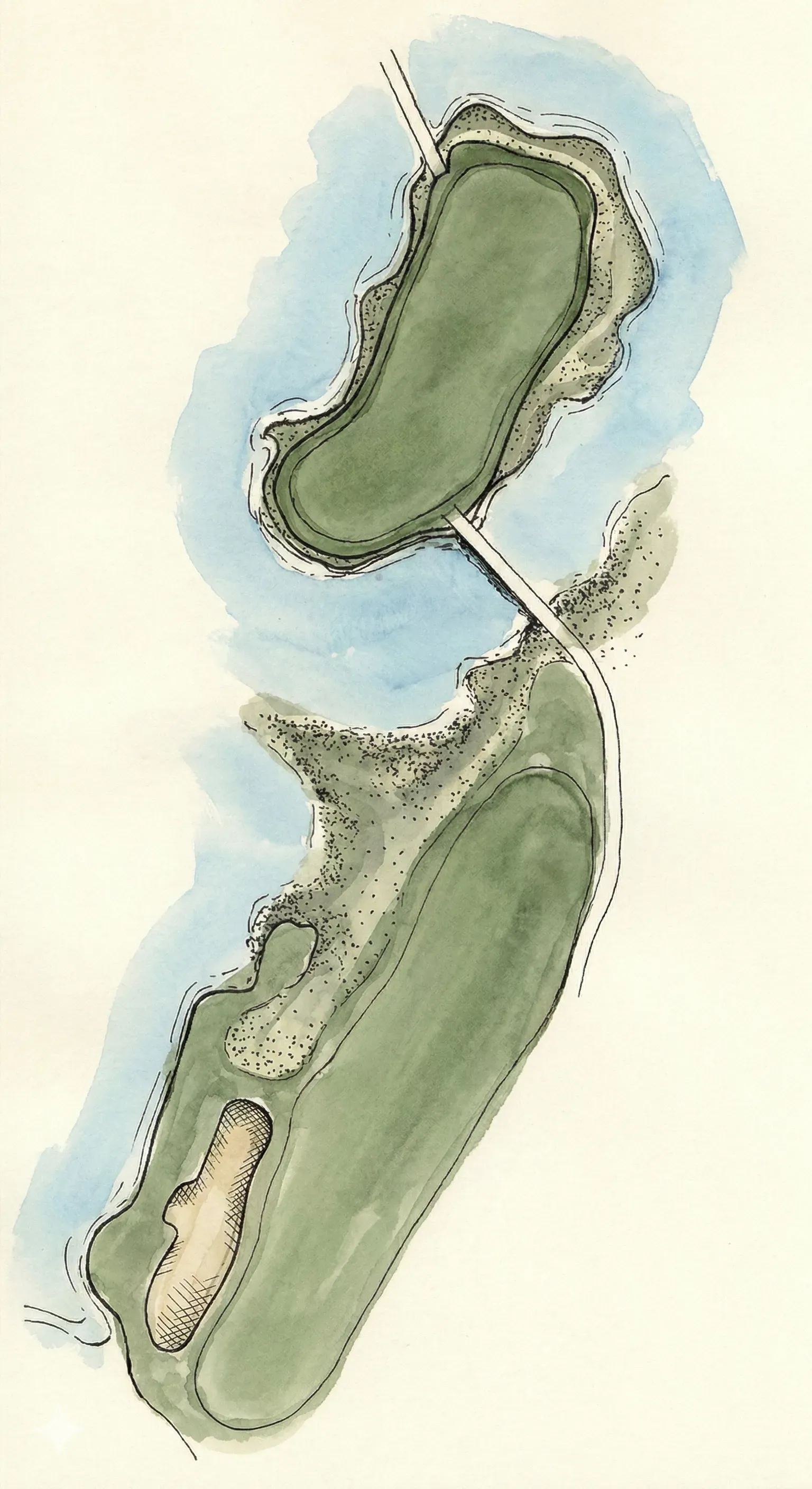
The eleventh presents the Biarritz template in a rigid, unforgiving context. Unlike inland variations that allow a running approach, Macdonald and Raynor placed this iteration across a tidal estuary, rendering the carry mandatory. The green itself is a vast peninsula of turf, bisected by a swale deep enough to hide the flagstick. To access a rear pin, one must land the ball on the front tier and trust gravity to navigate the valley, or challenge the wind with a towering flight to the back shelf.
Historically, this hole deviates from the template’s purity by removing the fairway approach, turning a strategic runner into a pure aerial demand. Yet, the geometry remains faithful. The scale of the green—restored to its original vastness by Gil Hanse—makes putting a secondary examination of nerve. It sits exposed to the heavy air of the Long Island Sound, where the wind acts as the primary defender and the tide dictates the penalty.
The walk to the green is one of anticipation or dread. A ball found in the swale offers a chance at par, provided one possesses the touch of a surgeon. A ball in the marsh belongs to the crabs. It is a hole that demands a pure strike, indifferent to the player’s ego or the scorecard’s plea for mercy.
Hole Stats
- Par
- 3
- Yardage
- 200
- Architect
- C.B. Macdonald & Seth Raynor
- Template
- Biarritz