 Lunchball
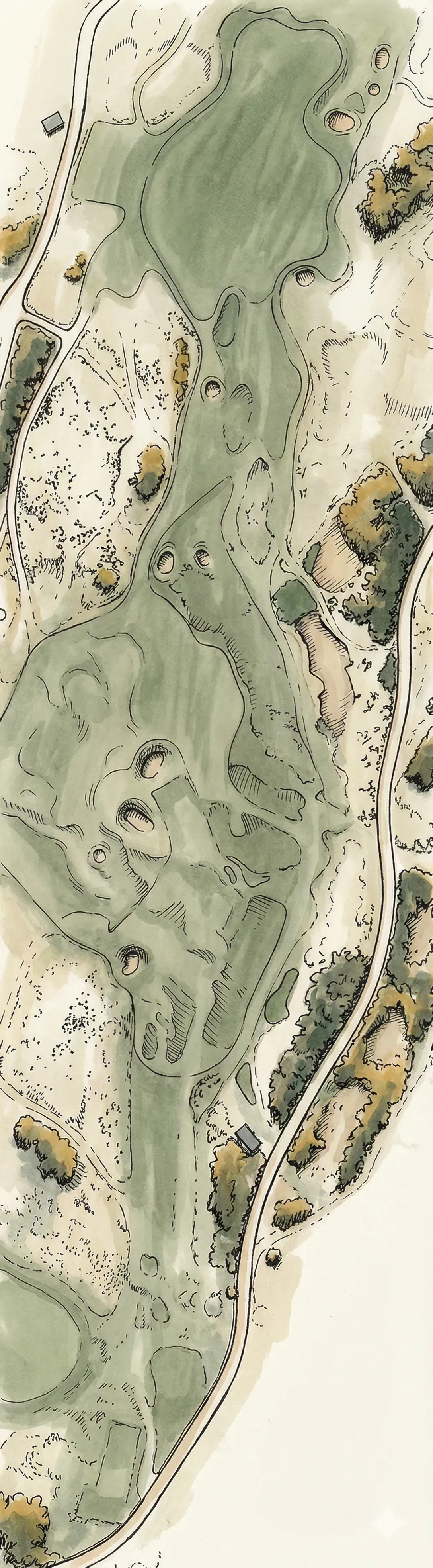
The thirteenth presents a stark geometrical problem that has tormented players for centuries. The ‘Coffin’ bunkers lie sunken in the fairway, often invisible from the tee but omnipresent in the mind. To steer left is to court architectural death; to steer right is to find the rough, often choked with gorse, leaving a long approach over a shoulder of land. The green is a vast, heaving plateau shared with the fifth hole, where the wind exposes every flaw in the ball’s flight and a putter is often required from forty yards out.
This hole marks the true beginning of the inward struggle against the prevailing wind. It does not rely on water or arbitrary boundaries, but on the firmness of the turf and the severity of the bunkering. While the layout has evolved under the stewardship of Old Tom Morris and others, the strategy remains ancient: the ground dictates the shot. The contours of the fairway act as a kick-plate, shoving indifferent drives toward the very hazards the player sought to avoid.
Standing on the tee, the air feels heavier here. The caddie offers a line, but the eyes drift involuntarily to the trouble. One swings with a prayer rather than a plan. Walking to the ball, there is a silent, desperate hope that the ground has been kind. Usually, it has not. To escape with a four is to have survived a negotiation with the land itself.
Hole Stats
- Par
- 4
- Yardage
- 465
- Architect
- Old Tom Morris