 Lunchball
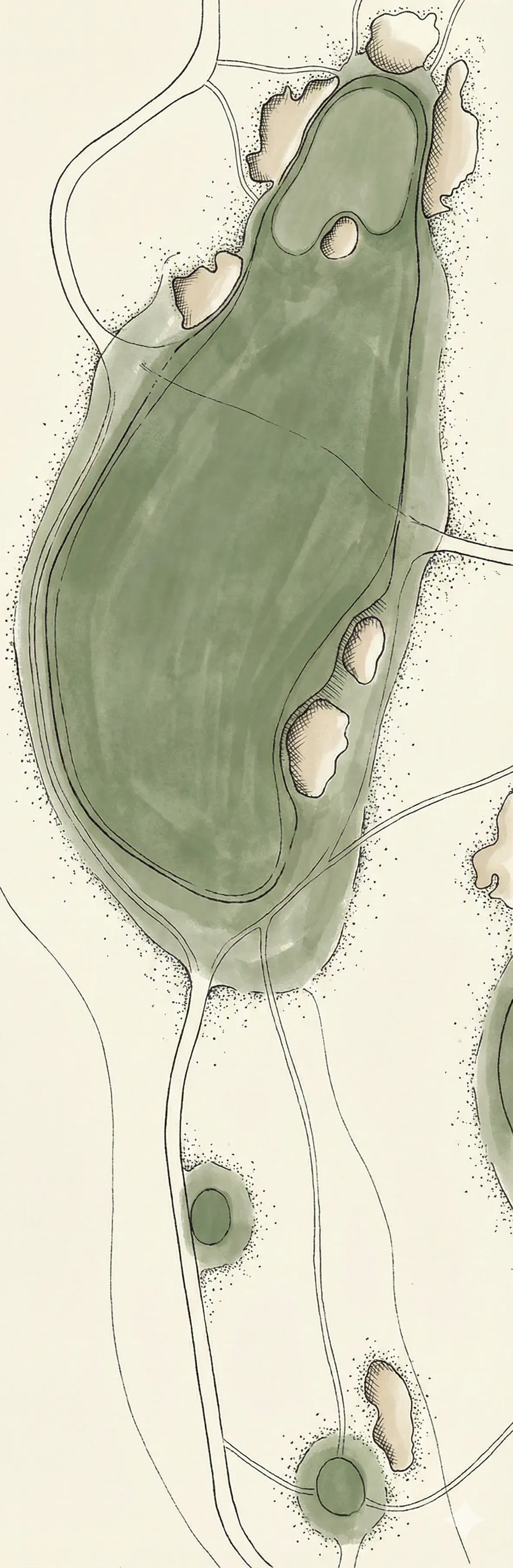
The tee shot presents a question of ambition, functioning effectively as an inland Cape. The fairway bends violently to the right, wrapping around a massive, scrub-covered dune that guards the corner like a fortress. To play safely to the left is to accept a longer approach into a green that runs away from the player. To challenge the corner—cutting across the chaotic blowouts—is to court disaster, yet a successful carry yields a simple pitch. The geometry forces a moral decision before the club is even drawn.
Bill Coore and Ben Crenshaw did not construct this routing so much as they uncovered it. In the mid-1990s, they walked these dunes until the land revealed its spine. The eighth is a testament to that discovery, requiring minimal earthmoving to establish a world-class strategic test. It stands as the definitive argument for the minimalist movement, proving that the most formidable hazards are those left untouched by heavy machinery.
Walking the fairway, the isolation of the Sandhills is absolute. There is only the sound of the wind tearing through the prairie grass and the dull thud of the ball meeting firm turf. The horizon is endless, the silence heavy. It is a place that demands a stoic appreciation for the ground game, where a well-struck shot is its own applause in the vast emptiness of Nebraska.
Hole Stats
- Par
- 4
- Yardage
- 367
- Architect
- Coore & Crenshaw
- Template
- Cape