 Lunchball
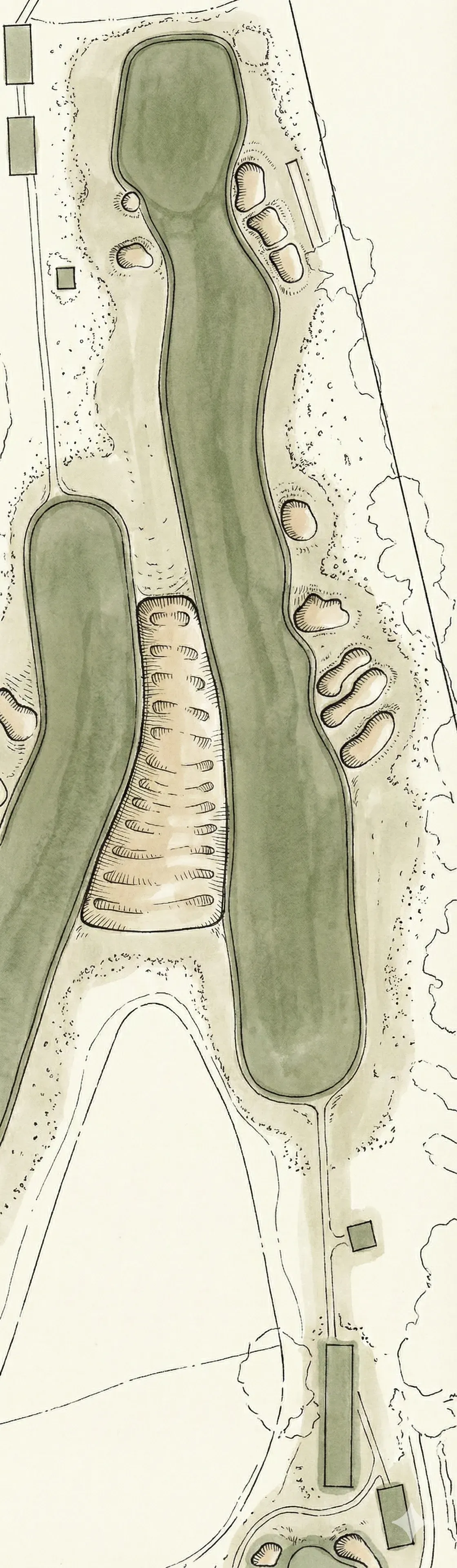
The topography rises immediately from the tee, obscuring the landing zone and forcing the player to trust their line against the skyline. To the left sits the defining feature: a massive hazard comprised of thirteen grass ridges separated by sand, looking for all the world like the seating in a cathedral of punishment. The fairway cambers aggressively from left to right, meaning a drive played safely away from the sand often bounds into the deep rough on the opposing side. The approach is no less severe, played uphill to a green that slopes front-to-back, repelling a ball that lacks sufficient spin.
Historically, these ridges were not a single sprawling hazard but separate trenches dug by Fownes to penalize the hooked drive. Over the decades, they merged into the singular entity that now haunts the nightmares of professionals and members alike. While modern equipment has shortened the hole on paper, the restoration work has sharpened the teeth of the bunkers, ensuring that recovery requires a wedge played sideways rather than a heroic lash toward the green.
There is a specific heaviness to the air on the third tee. The strategy suggests aiming at the third pew and hitting a fade; the nerves suggest closing the eyes and swinging hard. To find the fairway is a moment of brief relief, quickly replaced by the realization that the ball is above the feet and the target is blind. Walking off with a four is a triumph; walking off with a six is standard procedure.
Hole Stats
- Par
- 4
- Yardage
- 462
- Architect
- Henry Fownes