 Lunchball
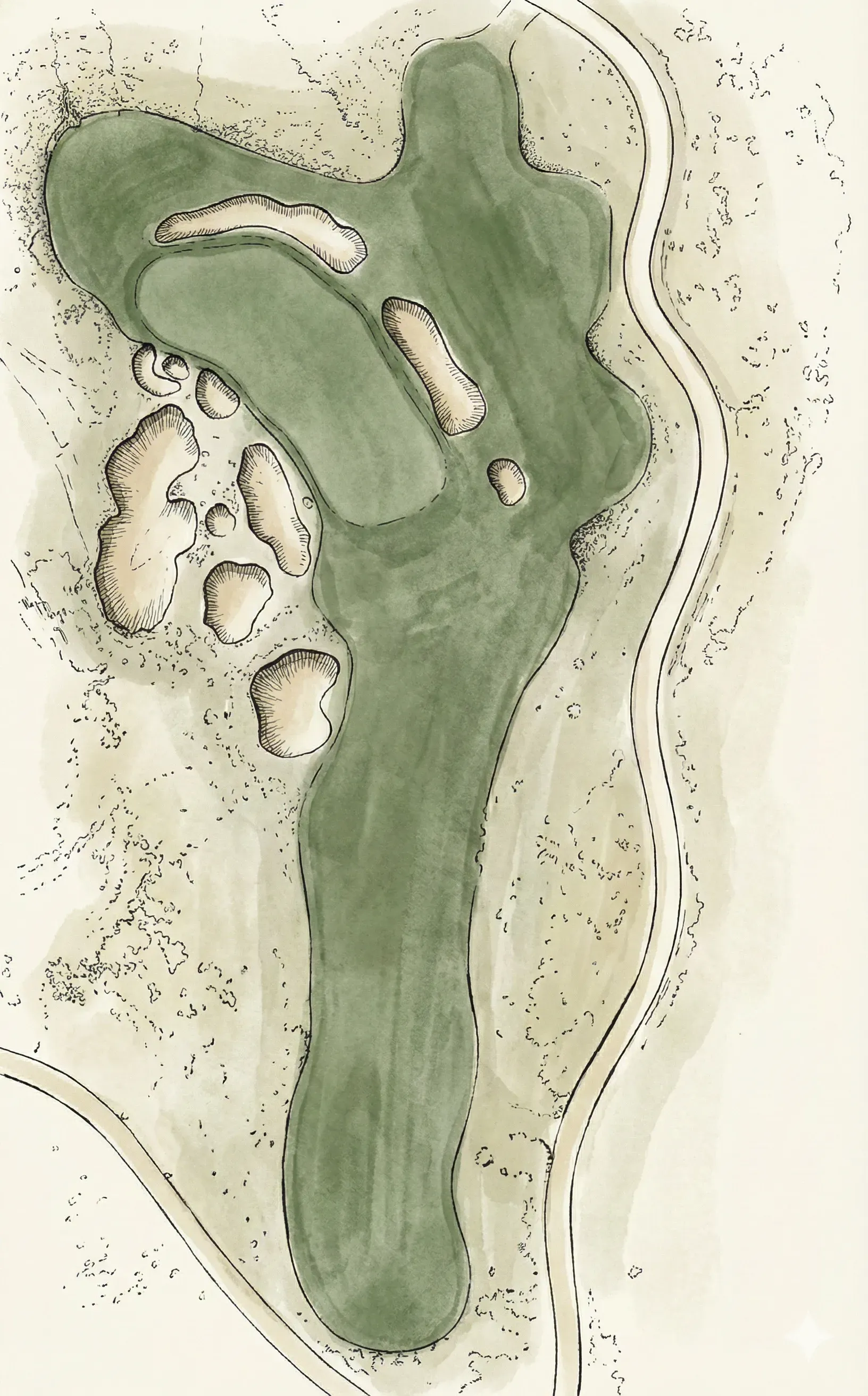
The eighth presents a question of temptation that has plagued golfers since the gutta-percha era. The yardage implies a moment of respite, but the topography suggests violence. A scarred ravine bisects the playing corridor, demanding a carry that feels heroic in the air and foolish upon landing. The prudent play—a safe play away from the pin — leaves the player with a long, terrifying putt down a green that runs away like spilled water. To score, one must challenge the ravine directly. It is a game of angles where geometry dictates success, not power.
Rob Collins and Tad King sculpted this landscape not by imposing order, but by exposing the raw scale of the Nebraska Loess Hills. While not a strict reproduction of a singular historic template, the hole echoes the strategic duality of the “Leven” links, where the line of charm is fraught with disaster. The green complex is a massive, heaving entity, utilizing a backstop that allows a well-struck drive to funnel toward the pin, provided the player has the nerve to aim away from the flag.
Walking onto the eighth tee, the wind usually arrives from the plains, stripping away the comfort of the short yardage. The strategy suggests center of the green; the ego screams aim for the pin. You stand over the ball, visualizing the high draw that rides the slope to birdie range. Moments later, you are in the bottom of the ravine, searching for a ball that has returned to the earth, while your partner, who boringly hit a hybrid, marks down a three. The land does not care about your intentions.
Hole Stats
- Par
- 3
- Yardage
- 100
- Architect
- King-Collins Golf Course Design