 Lunchball
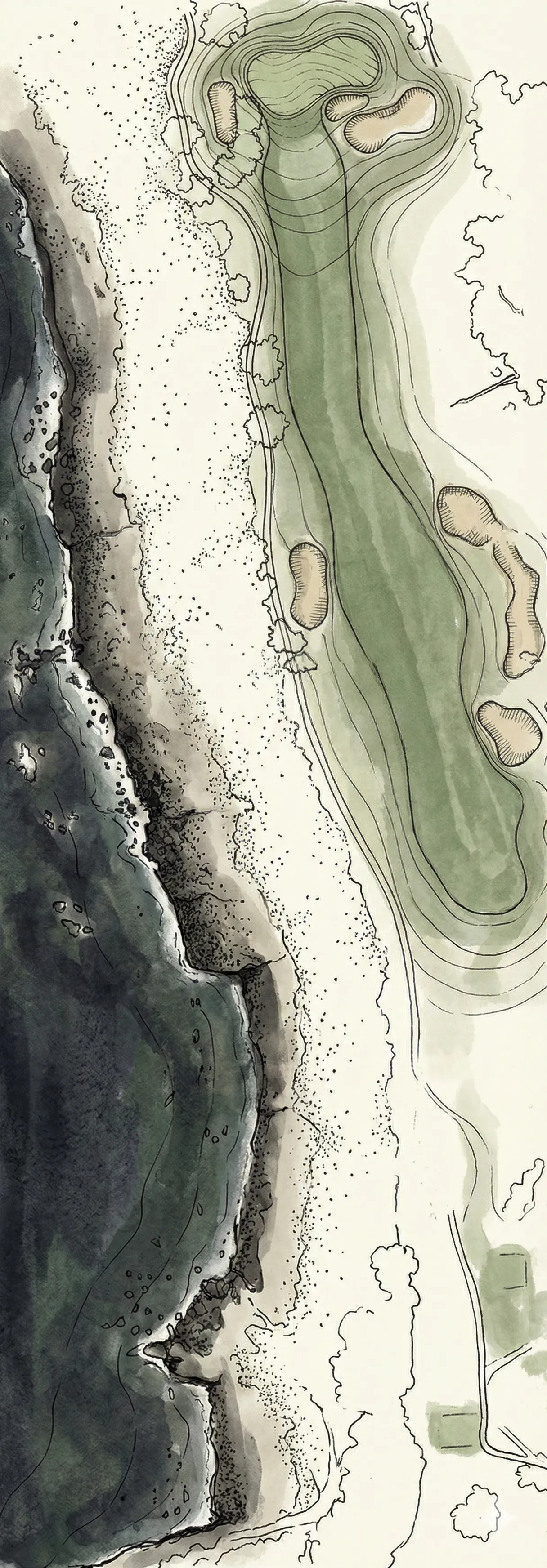
The land here plunges into Sagami Bay. This is a par 5 of immense scale, where the fairway traces the spine of the cliff like a fragile artery. The instinct is to steer the drive well right, into the safety of the hillside, but Alison anticipated this cowardice. He placed deep, cavernous pits—the infamous ‘Alison Bunkers’—to catch the fearful. To find the green in regulation, one must flirt with the void on the left, trusting the camber to hold the ball against the onshore breeze.
C.H. Alison’s trek to Japan in 1930 fundamentally altered the country’s architectural lineage. At Kawana, he found a canvas that rivaled the California coast, yet he applied a heavier hand. The bunkering is large-scale and penal, a necessary counterweight to the vastness of the ocean backdrop. It is not merely a scenic hole; it is a strategic examination of nerve, where the hazards are both man-made and geological.
The walk from tee to green is a sensory assault. The air is thick with salt, and the roar of the waves drowns out the polite chatter of the foursome. There is a heaviness to the atmosphere here, a feeling that the course is merely tolerating our presence on its edge. We hit our shots, hope for a favorable kick, and move quickly, lest the cliff decides to reclaim the fairway.
Hole Stats
- Par
- 5
- Yardage
- 568
- Architect
- C.H. Alison