 Lunchball
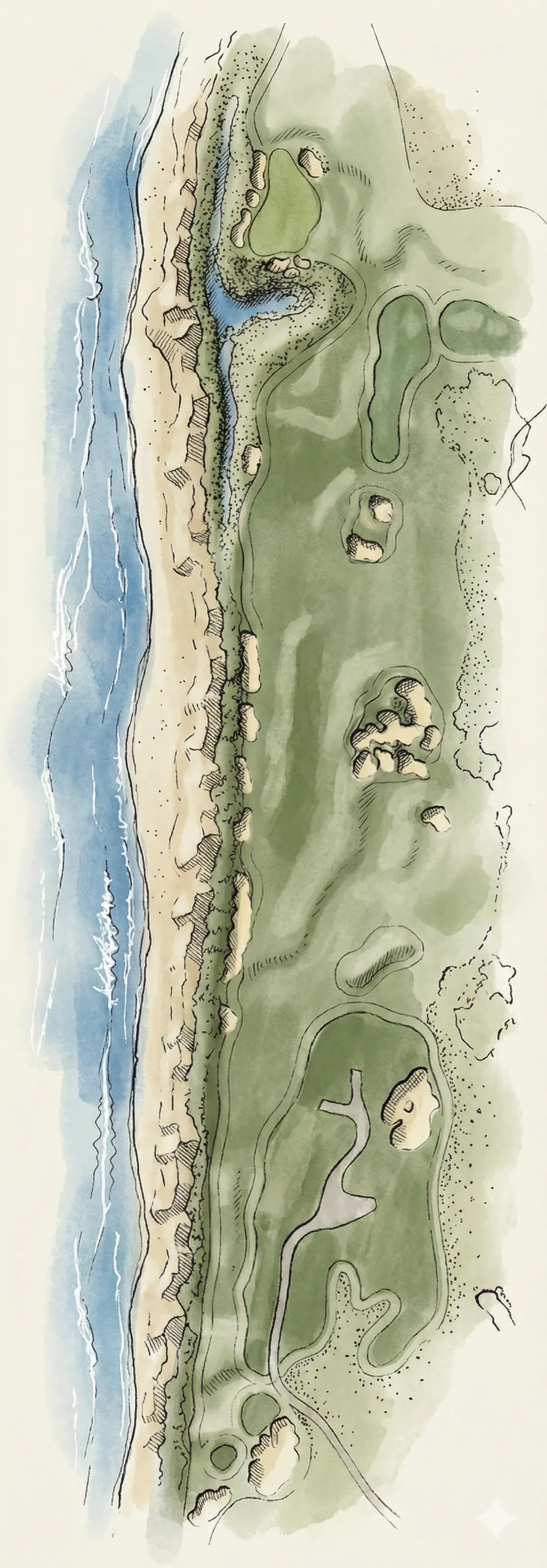
The tenth creates a schism in the mind. The topography cleaves the fairway in two, separated by a scarred ravine of sand and scrub. To the right lies safety—a paddock of turf offering a secure par but forbidding a birdie. To the left, a forced carry over the breach asks for a heroic lash against the prevailing wind. The reward is a bounding line to the green; the penalty is a reloading of the pocket. The green complex itself appears carved from the cliff edge, rejecting the timid approach.
Though a modern creation, the hole feels excavated rather than constructed. Coore and Crenshaw allowed the chaotic geology of Inverness to dictate the terms. It creates a psychological pressure reminiscent of the great hazard holes of the heathlands, yet transported to the violent winds of the Gulf of St. Lawrence. It stands as a testament to the Second Golden Age—proof that earthmoving equipment need not destroy the soul of a landscape if the hand on the lever is gentle.
Walking up the fairway, the sound of the ocean swallows the conversation. The wind whips the fescue against the ankles, a constant reminder of the environment’s hostility. It is a place to pull the collar up and trust the ground game. A par here feels stolen from nature; a bogey feels like a fair tax paid to the gods of the Atlantic.
Hole Stats
- Par
- 5
- Yardage
- 557
- Architect
- Coore & Crenshaw