 Lunchball
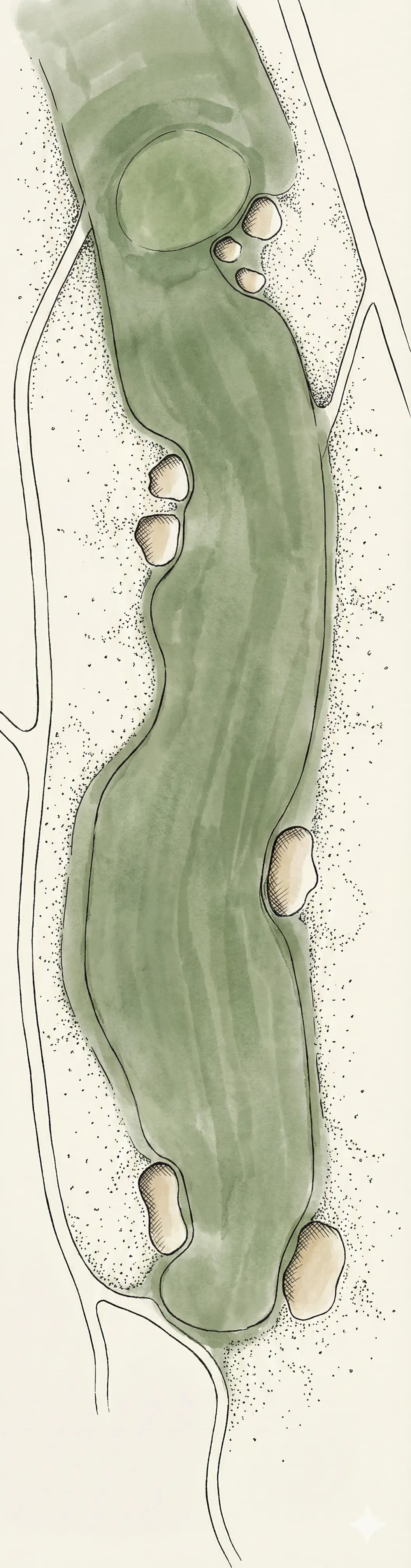
The back nine begins with a plunge into the ancient topography. The fairway creates a sensation of vertigo, tumbling downward through the hills with a camber that rejects straight lines. It is a drive that demands commitment to a blind landing zone, followed by an approach from a lie that is never level. The ball invariably sits below the feet, encouraging a fade, while the green—a Flynn masterpiece—hunts for the ball to cast it off the back edge. It is a hole of gravity and momentum.
While the ghost of Stanford White haunts the clubhouse, it is William Flynn’s 1931 routing that speaks loudest here. This hole captures the essence of his genius: the refusal to flatten the earth. Where lesser men might have bulldozed a plateau, Flynn draped the fairway over the heaving ground like a linen sheet over a messy bed. It remains one of the finest utilizations of natural topography in American golf, requiring the player to read the land rather than a yardage book.
Standing on the tee, the wind off Peconic Bay strips away any lingering arrogance from the front nine. The clubhouse sits high behind you, watching with indifference. There is no comfort here, only the stark reality of the descent and the knowledge that a par requires a delicate touch on a putting surface that behaves more like a polished floor than grass. It is a rude, beautiful awakening to the inward half.
Hole Stats
- Par
- 4
- Yardage
- 415
- Architect
- William Flynn