Lunchball
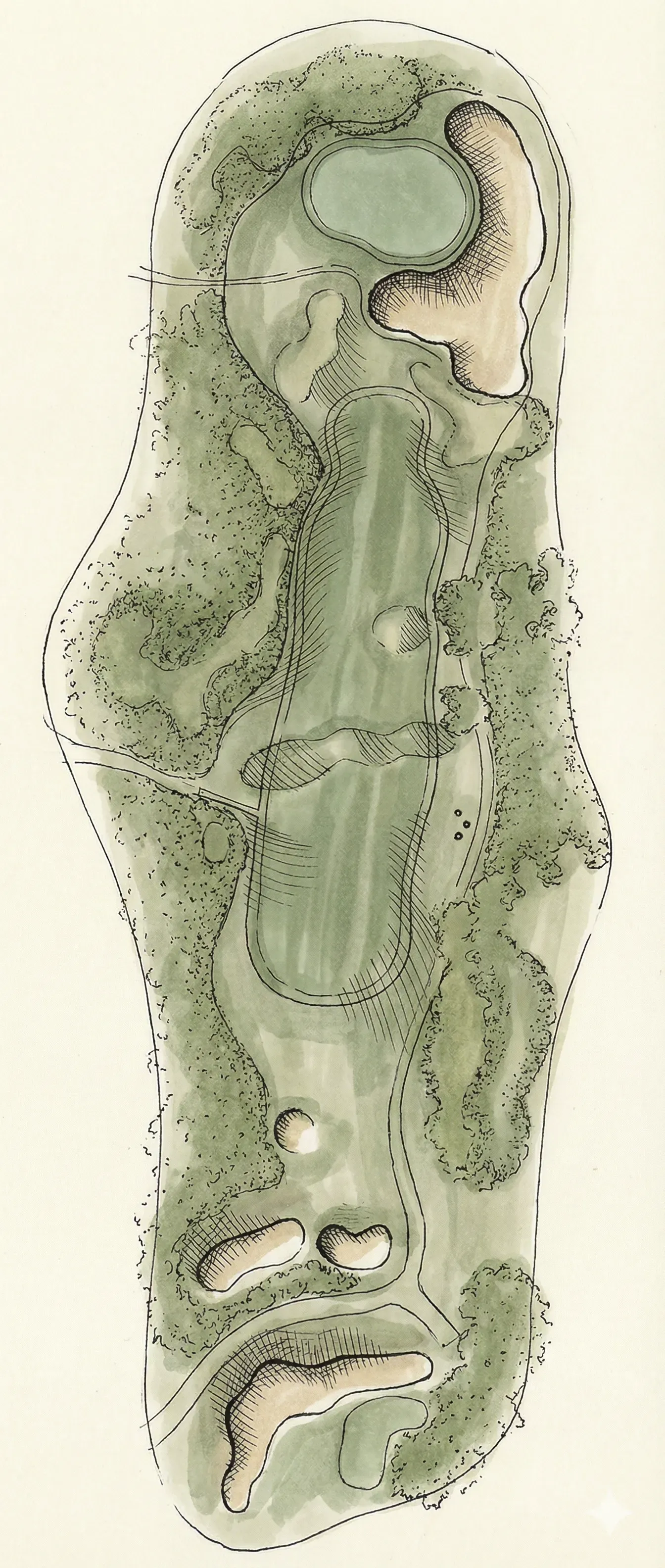
The 17th at Prestwick does not negotiate; it obscures. Here lies the progenitor of the “Alps,” the ancestor to every blind approach that has plagued the psyche of the golfer for nearly two centuries. The requirement is geometrically simple but psychologically taxing: secure the fairway—preferably finding a flat stance among the hummocks—and then confront the great dune. The green remains unseen, a rumor hidden behind a wall of marram grass. Between the launch and the landing lies the Sahara, a bunker of vast depth that rejects the concept of recovery. The hole strips away visual comfort, demanding the player trade sight for conviction.
This ground is hallowed, laid out by Old Tom Morris in 1851 as part of the loop that welcomed the inaugural Open Championship. It survives not as a museum piece, but as a rebuke to the modern game. While technology has trivialized distance, it cannot flatten the topography. The hole stands as a testament to an era when architecture was not the art of moving earth, but the audacity of routing a game across it. The land dictates the terms; the golfer must simply cope.
If a contemporary architect submitted these plans today, they would be accused of malpractice. Because the signature belongs to Morris, we call it “charm.” Standing in the fairway, staring at a mountain of turf with a scorecard in hand, one realizes the absurdity of the pursuit. The strategy is reduced to superstition: pick a cloud, trust the swing, and walk. The ascent up the dune to discover one’s fate—whether one has held the green or fallen into the pit—provides a jolt of adrenaline that explains why we endure the wind and the rain.
Hole Stats
- Par
- 4
- Yardage
- 394
- Architect
- Old Tom Morris
- Template
- Alps