Lunchball
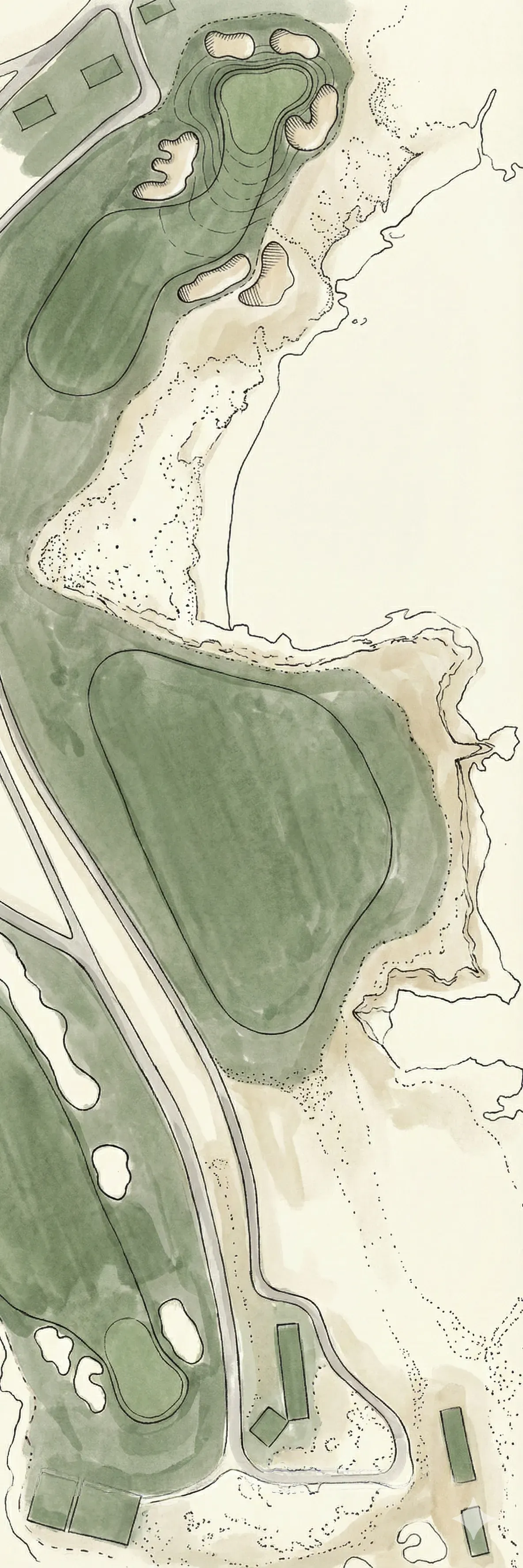
The tee shot offers a false sense of security, a blind uphill climb that reveals nothing of the drama waiting beyond the crest. Upon reaching the summit, the fairway is severed by the Pacific Ocean. The approach is a study in terror: a mid-iron that must carry a gaping chasm of saltwater to a green tilted precariously on the opposite cliff. There is no bail-out, no safe miss. The geometry is absolute.
When amateurs Jack Neville and Douglas Grant walked this land in 1919, convention dictated a route inland, away from the crumbling edge. They chose instead to invite the ocean into the field of play. It was a decision of architectural defiance. The hole does not ask for shape; it asks for distance control and nerve. It is a par four that feels like a par five psychologically.
The walk from the fairway edge to the green is one of the great pilgrimages in the sport. Standing over the ball, with the wind howling off Carmel Bay and the surf crashing a hundred feet below, the scorecard becomes irrelevant. The ego suggests you can muscle a short iron through the gale; the ocean suggests otherwise. One hopes merely to arrive on the other side with the same ball one started with.
Hole Stats
- Par
- 4
- Yardage
- 427
- Architect
- Jack Neville & Douglas Grant
- Template
- Heroic