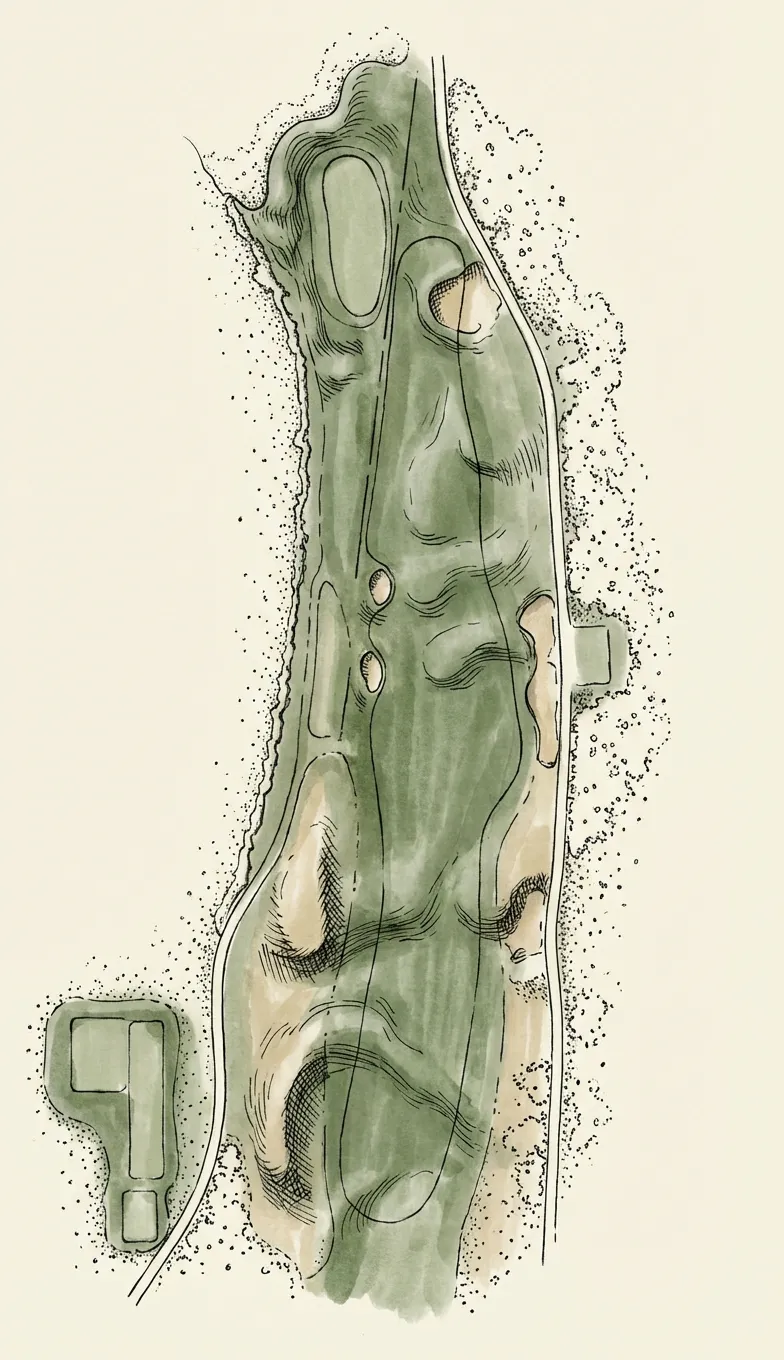
Lunchball
Modern architecture obsesses over fairness; this hole rejects the concept entirely. It serves as the primitive ancestor of the ‘Wall’ template, a design of blunt force and simple strategy. The drive negotiates a narrow corridor of dune, but the approach remains the primary query. A dry-stone sheep wall cuts perpendicular across the line of play, severing the fairway from the putting surface. The green lies interred in a hollow immediately behind the stone, rendering the ground game useless. The shot must be aerial, towering, and soft, lest it meet the unforgiving resistance of Scottish masonry.
North Berwick preserves the architectural fossils that elsewhere have been smoothed over by bulldozers and committees. The wall was not erected for sport; the sport was draped over the boundary, accepting the land as it was found. While the Redan (15th) and the Biarritz (16th) garner the academic praise, the 13th remains the truest testament to the era of David Strath. It embodies the Victorian refusal to move the earth when one could simply hit over it.
In the United States, such a hazard would summon a fleet of personal injury lawyers; in East Lothian, it merely summons a penalty stroke. There is a specific, hollow violence to the sound of a ball striking the stone—a sharp clack that echoes off the dunes before the ball ricochets back toward the player. If the approach finds the base of the wall, geometry offers no escape. One must chip sideways, or backwards, accepting that the stonework has won. It is a place where par feels like theft, and the scorecard is at the mercy of a pile of rocks.
Hole Stats
- Par
- 4
- Yardage
- 400
- Architect
- David Strath
- Template
- The Pit (Original)