 Lunchball
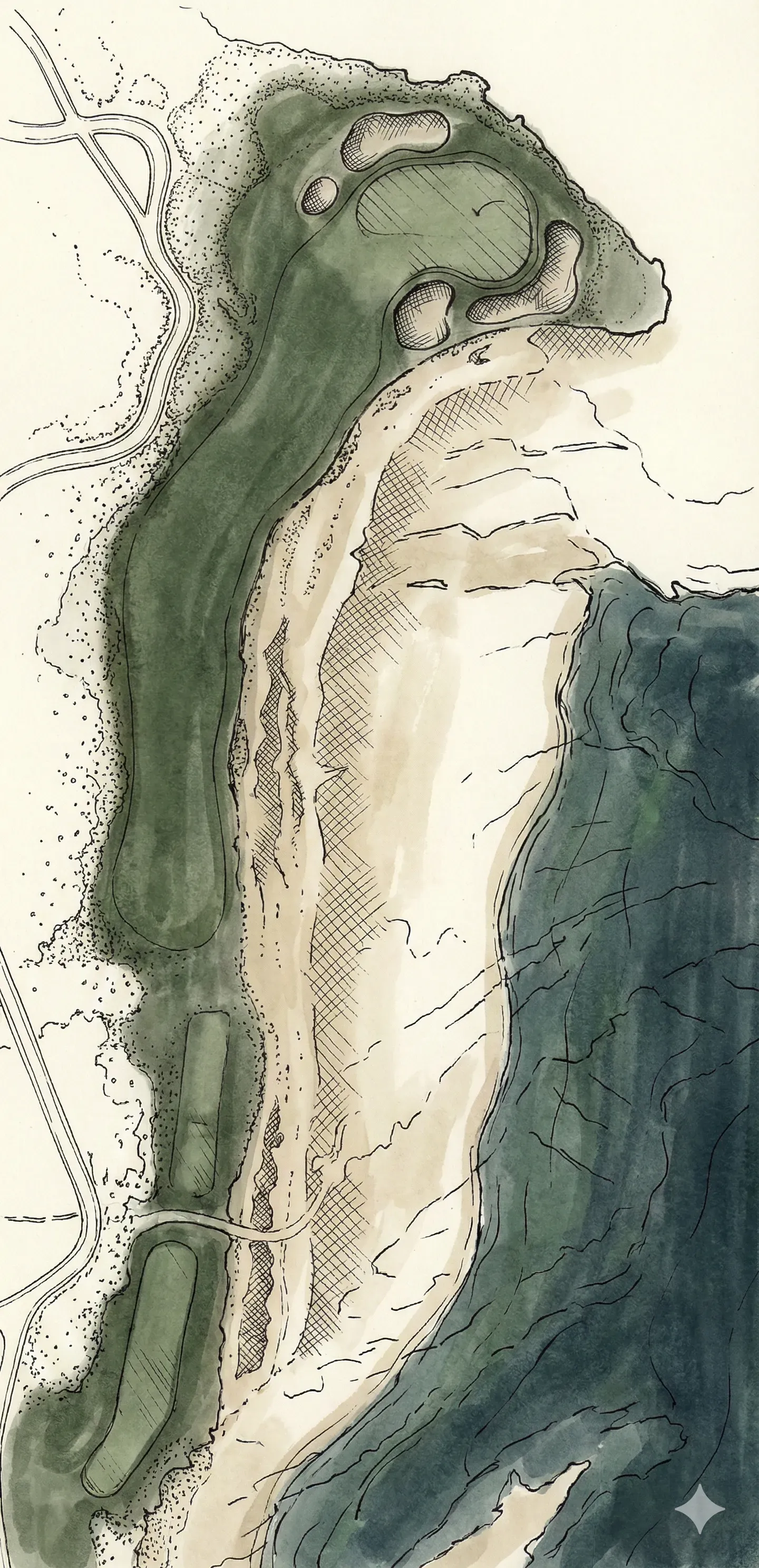
The 15th, ‘Rocky Ness,’ demands a trajectory over a churning inlet of the North Sea. The green sits isolated on a rocky spur, a shelf of turf seemingly claimed from the water by force. While the eye is drawn to the whitecaps, the architecture plays a quieter trick: the target is actually receptive, gathering shots struck with conviction. The bail-out to the left offers dry land, but leaves the player entangled in rough and angles that fight the par. It is a moment that asks the golfer to trust the swing over the survival instinct.
There is a deception at work here, executed with absolute precision. Before the turn of the millennium, this ground was not a dune-scape but a flat expanse of arable farmland, destined for turnips rather than pot bunkers. Kyle Phillips did not discover this hole; he manufactured it. The craggy inlet and the weathered rock face appear eroded by ten thousand years of tides, yet they are the product of heavy machinery and vision. It is a fabrication, certainly, but one that feels more authentic than the geology it replaced.
On the tee, the air feels old, even if the turf is young. The mind knows this is engineering, but the heart recognizes it only as linksland. The distinction matters little when the ball is in flight against a grey sky. We accept the illusion because the wind is real, the spray is cold, and the demand on the swing is absolute.
Hole Stats
- Par
- 3
- Yardage
- 212
- Architect
- Kyle Phillips