Lunchball
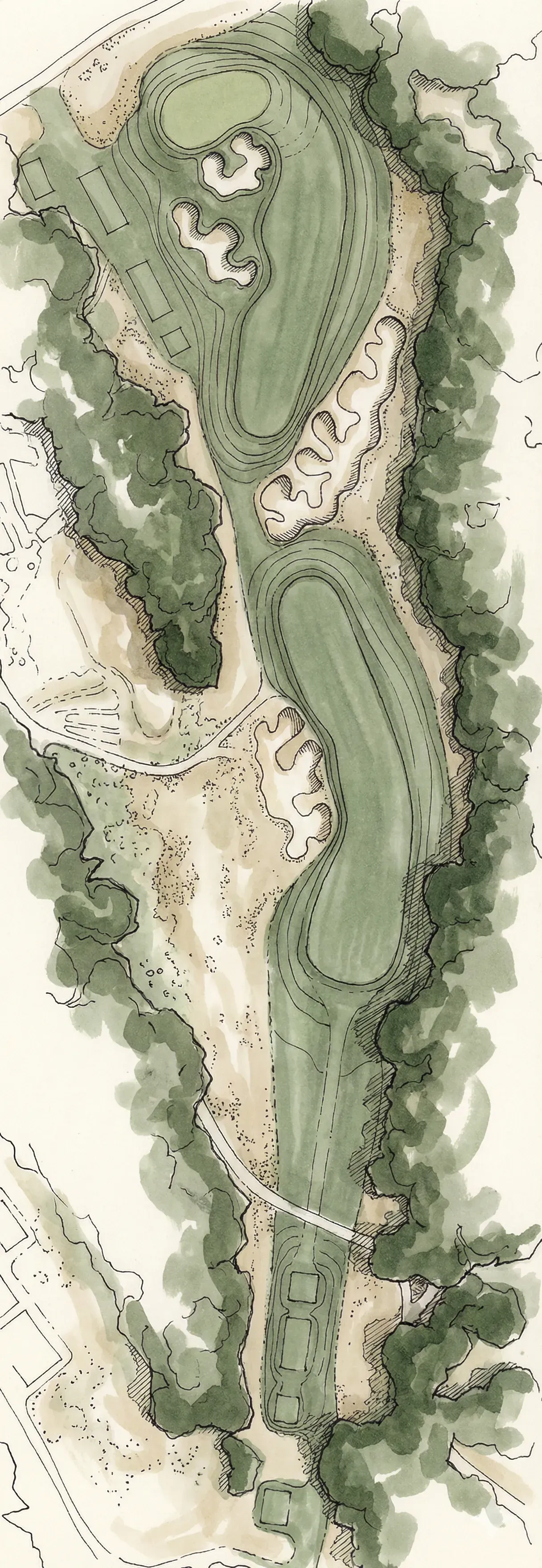
Here lies Tillinghast in his most unsparing form. The hole serves as a violent expression of the ‘Great Hazard’ template. Though charted as a double dogleg, the routing is defined by the sandy scar that severs the fairway—a pit of such scale it renders the landscape alien. The tee shot demands a fade to hold the upper shelf, but the architecture reserves its harshest interrogation for the second swing. The player must choose between hubris and survival: challenge the cross-bunkers to reach the elevated surface, or lay up short, accepting that a par will require a surgeon’s touch with a wedge.
Constructed during the lean years of the Depression, the earth here bears the heavy mark of WPA labor. The bunkers illustrate the ‘Glacier’ concept; they do not merely sit in the slope but appear to slide down it, a cascade of silica arrested in motion. While Rees Jones has since put his knife to the grounds for the Open, the primary threat remains unchanged: a bunker complex rising to meet the eye like a breaking wave.
To play this hole is to accept physical and mental exhaustion. The lungs burn from the climb; the mind clouds from the geometry. Should the second shot find the bottom of the Great Hazard, the gentleman’s play is to pocket the ball. We are not contesting the Claret Jug, and the energy is better spent on the vertical hike to the green. It is grand, severe, and the precise reason one sleeps in a car to secure a time.
Hole Stats
- Par
- 5
- Yardage
- 517
- Architect
- A.W. Tillinghast
- Template
- Great Hazard